

Eurosystem staff macroeconomic projections for the euro area, June 2026
The economic outlook for the euro area remains highly uncertain in the context of the war in the Middle East, the closure of the Strait of Hormuz and elevated oil price volatility. Some of the risks identified in the March 2026 ECB staff projections have started to materialise, with oil prices increasing further, supply chain pressures emerging, and markets now expecting the impact of the conflict to be more protracted. In the June 2026 Eurosystem staff baseline projections it is assumed that energy prices will decline relatively rapidly in the course of the next few quarters, in line with futures prices.[1] However, the evolution of the conflict, together with its impact on energy prices, on the prices of some non-energy commodities and on economic activity, as well as the pass-through of the energy price shock to non-energy consumer prices, remain subject to considerable uncertainty. Therefore, in addition to the baseline, alternative scenarios have been prepared which assume varying degrees of intensity of the energy shock and its impact on the euro area economy.
Short-term indicators point to subdued economic growth in the near term, as higher energy prices and greater uncertainty weigh on domestic demand. In particular, as rising energy costs erode real disposable income and dampen consumer sentiment, household consumption growth – which was a key driver of growth in 2025 – is projected to slow considerably this year. Conditional on a relatively rapid resolution of the conflict and a related reduction in uncertainty, this weakness in private consumption growth is expected to be temporary. Over the medium term domestic demand should be bolstered by a recovery in real disposable income, owing to falling energy prices and a resilient labour market, and by rising government spending on infrastructure and defence, especially in Germany, complemented by investment related to artificial intelligence (AI). On the external side, export growth is expected to remain constrained by persistent competitiveness challenges, with euro area exporters experiencing further declines in their global market shares. The baseline projections foresee annual real GDP growth of 0.8% in 2026, 1.2% in 2027 and 1.5% in 2028. Compared with the March 2026 projections, GDP growth has been revised down by 0.1 percentage points for both 2026 and 2027, reflecting the stronger than previously expected impact of the war in the Middle East, while for 2028 it has been revised up by 0.1 percentage points as this impact is seen to unwind.
The baseline projections see headline inflation, as measured by the Harmonised Index of Consumer Prices (HICP), peaking at 3.4% in the third and fourth quarters of 2026 and remaining above 3.0% until early next year, driven by a surge in energy inflation as a result of the conflict in the Middle East. This mostly reflects a strong and immediate pass-through of higher crude oil prices to consumer fuel prices, amplified by additional pressures on prices of refined oil products. As most of the war’s impact on energy prices drops out of the year-on-year comparison, headline inflation is expected to fall sharply to 2.3% in the second quarter of 2027 and to hover around 2.0% thereafter. This profile for headline inflation masks diverging patterns across the main components. Decreases in energy commodity prices, as embedded in futures prices, as well as large base effects, imply that energy inflation would decline, turning negative in 2027, and would then tick up in 2028, owing to the introduction of the EU Emissions Trading System 2 (ETS2). By contrast, the energy shock is expected to feed through gradually to the non-energy components of the HICP, with inflation in these components continuing to increase up to the middle of 2027, partly offsetting the decline in inflation in the energy component, before moderating again in 2028. Food inflation is projected to peak at 3.7% in the second quarter of 2027 and then to ease in 2028. Similarly, HICP inflation excluding energy and food (HICPX) is projected to increase to a peak of 2.7% in early 2027 and then to moderate from the second quarter of the year. Indirect and second-round effects from the current energy shock are expected to be smaller than those seen in 2021-24, tempered by the weaker outlook for aggregate demand (which is expected to limit inflation compensation effects on wages), the past appreciation of the euro, and ongoing import penetration from China. At the same time, it is assumed that supply chain bottlenecks will not significantly amplify overall cost pressures. Overall, the baseline projections foresee HICP inflation picking up from 2.1% in 2025 to 3.0% in 2026, before declining to 2.3% in 2027 and then returning to target, at 2.0% in 2028. Compared with the March 2026 projections, the outlook for HICP inflation has been revised up by 0.4 percentage points for 2026 and 0.3 percentage points for 2027, largely on account of higher energy and food price assumptions, including stronger indirect effects on non-energy inflation. For 2028, it has been revised down by 0.1 percentage points, partly owing to a sharper than previously assumed decline in oil prices. HICPX inflation has been revised up by 0.2, 0.3 and 0.1 percentage points for 2026, 2027 and 2028 respectively, reflecting both higher services and non-energy industrial goods (NEIG) inflation in 2026-27 and higher NEIG inflation in 2028.
Alternative assumptions regarding the magnitude and persistence of the war in the Middle East and the energy price shock, their impact on the international environment and uncertainty, and propagation of the impact via indirect and second-round effects, would lead to markedly different macroeconomic outcomes. To illustrate this uncertainty, staff have prepared three alternative scenarios – an adverse scenario, a severe scenario and a milder scenario. These scenarios offer illustrative examples of alternative paths for energy commodity prices and their transmission to the euro area economy – they are not forecasts and staff do not assign any probabilities to them.
- The adverse scenario assumes a sharper and more persistent increase in energy prices than in the baseline. It also incorporates higher uncertainty and larger international spillovers, as well as stronger indirect and second-round effects on inflation. Relative to the baseline, it implies higher inflation in 2026-28 (Table 1). Conversely, GDP growth would be lower than in the baseline in 2026 and 2027 and the same as the baseline in 2028.
- The severe scenario assumes a stronger and more persistent energy price shock, greater uncertainty and a stronger reaction from wages and non-energy prices than in the adverse scenario. Relative to the baseline, it entails significantly and persistently higher headline inflation across the projection horizon, consistent with past experience of non-linearities in the face of a large energy price shock. GDP growth would slow considerably in 2026-27, before rebounding slightly faster in 2028 than foreseen in the baseline, reflecting the rise in income and in demand resulting from stronger responses from wages.
- Finally, in the milder scenario oil prices would normalise more rapidly than in the baseline, implying a faster moderation in inflation, which would fall below the 2% target in 2027 and 2028, while GDP growth would recover somewhat earlier and more robustly than in the baseline.
Table 1
Growth and inflation projections for the euro area
(annual percentage changes)
|
|
March 2026 baseline |
June 2026 – baseline projections and alternative scenarios |
||||
|---|---|---|---|---|---|---|---|
Baseline |
Milder scenario |
Adverse scenario |
Severe scenario |
||||
Real GDP |
2025 |
1.5 |
1.5 |
1.5 |
1.5 |
1.5 |
|
2026 |
0.9 |
0.8 |
0.8 |
0.7 |
0.5 |
||
2027 |
1.3 |
1.2 |
1.4 |
0.9 |
0.4 |
||
2028 |
1.4 |
1.5 |
1.6 |
1.5 |
1.6 |
||
HICP |
2025 |
2.1 |
2.1 |
2.1 |
2.1 |
2.1 |
|
2026 |
2.6 |
3.0 |
2.9 |
3.3 |
4.0 |
||
2027 |
2.0 |
2.3 |
1.8 |
3.0 |
5.3 |
||
2028 |
2.1 |
2.0 |
1.8 |
2.3 |
3.0 |
||
HICP excluding energy and food |
2025 |
2.4 |
2.4 |
2.4 |
2.4 |
2.4 |
|
2026 |
2.3 |
2.5 |
2.4 |
2.5 |
2.5 |
||
2027 |
2.2 |
2.5 |
2.3 |
2.7 |
3.8 |
||
2028 |
2.1 |
2.2 |
2.1 |
2.3 |
2.9 |
||
Notes: Real GDP figures refer to annual averages of seasonally and working day-adjusted data. Historical data may differ from the latest Eurostat publications owing to data releases after the cut-off date for the projections. Data for the baseline projections are available for downloading, also at quarterly frequency, from the Macroeconomic Projection Database on the ECB’s website.
2.1 Real economy
The euro area economy has been relatively resilient in the face of the trade and uncertainty shocks that occurred during 2025 and in the first quarter of 2026, abstracting from volatility in Irish data. According to Eurostat’s flash estimate, real GDP rose by 0.1% in the first quarter of 2026.[2] An adjusted measure of euro area GDP growth that uses “modified domestic demand” instead of GDP for Ireland rose by 0.2% in the same period, which was marginally less than foreseen in the March projections and down from the growth rate of 0.4% recorded in the fourth quarter of 2025 (Chart 1, panel a).[3] As the war in the Middle East started towards the end of the first quarter of 2026, it did not have a significant negative impact on the growth outturn for that quarter.
The conflict in the Middle East is weighing on the short-term growth outlook, with energy price shocks and uncertainty proving stronger and more persistent than previously expected, further reducing purchasing power and confidence. Survey data available up to May point to a deterioration in growth momentum since the start of the war in the Middle East. The composite output Purchasing Managers’ Index (PMI) fell slightly to 48.6 in May, after a sharp deterioration in April. This was driven by a drop in the PMI for manufacturing output – although it remained above the threshold signalling growth, in part owing to stockbuilding in response to potential supply disruptions resulting from the conflict in the Middle East. Forward-looking PMI indicators improved somewhat from the troughs recorded in April, but suppliers’ delivery times lengthened further. Similarly, the European Commission’s Economic Sentiment Indicator fell sharply in April, mainly because of worsening sentiment among households and in the services sector, although it stabilised somewhat in May. These broadly negative signals from survey data for the short-term growth outlook are offset in part by an assumed strong increase in Irish GDP growth, which, however, is surrounded by considerable uncertainty (Chart 1, panel a). When modified domestic demand is used for Ireland, the slowdown is more pronounced, with euro area growth declining from 0.2% in the first quarter to 0.1% in the second and third quarters, before edging up to 0.2% in the fourth quarter. This implies downward revisions of 0.1 percentage points for the third and fourth quarters compared with the March projections and more subdued trade and consumption dynamics than previously expected.
Chart 1
Euro area real GDP
a) Real GDP growth
(quarter-on-quarter percentage changes and percentage point contributions, seasonally and working day-adjusted quarterly data)

b) Real GDP levels
(index, Q1 2024 = 100)

Notes: Historical data may differ from the latest Eurostat publications. The vertical lines indicate the start of the current projection horizon. In panel a), the red bars refer to the impact of Irish real GDP growth on the euro area aggregate and the yellow bars refer to growth in the other euro area countries.
Real GDP growth is projected to increase from 0.8% in 2026 to 1.2% in 2027 and 1.5% in 2028 as domestic demand recovers, conditional on the underlying assumptions embedded in energy price futures that the shock is temporary and that the contribution of net exports will turn positive in 2027 (Chart 2). Private consumption is projected to make the largest contribution to growth in the medium term, followed by robust investment dynamics. In terms of expenditure components:
- Household consumption is expected to be subdued in the short term, owing to losses in purchasing power and higher uncertainty, but should strengthen in the medium term. Consumer confidence has weakened noticeably since the start of the war in the Middle East, pointing to more cautious consumption behaviour. Looking ahead, private consumption growth is expected to strengthen, supported by a recovery in real wage growth – after the dip in 2026 owing to higher inflation – and still resilient labour markets. The household saving ratio is seen to be volatile in the short term as households attempt to smooth their consumption in the face of the energy shock. The smoothing of consumption is seen to be supported by fiscal measures related to energy prices in some countries, while precautionary motives are seen to temporarily exert some upward pressure on savings. The saving rate is expected to gradually decline over the medium term from still elevated levels (falling from 14.5% of disposable income in 2025 to 13.9% in 2028) as uncertainty recedes, precautionary motives wane and confidence improves towards its historical norm.
- Government consumption is expected to continue supporting medium-term growth. However, it is seen to contribute somewhat less over the projection horizon than in recent years. An expected slight slowdown in 2027 is mainly on account of the expiry of Next Generation EU (NGEU) funding in some countries and further budgetary savings in others (see also Box 3).
- Despite weakening somewhat in 2026, investment is expected to outpace GDP growth throughout the projection horizon as uncertainty related to the war in the Middle East recedes, digitalisation efforts intensify and defence and infrastructure spending increases. The conflict in the Middle East is expected to dampen private investment in the near term as a result of heightened uncertainty and lower demand. Business investment (excluding volatile Irish intellectual property product investment) is expected to start to recover from the second half of this year, despite tighter financing conditions, as uncertainty regarding energy prices, the conflict in the Middle East and supply chain bottlenecks is assumed to recede. This recovery should be further supported by improving demand and by digitalisation efforts in the face of rapid advances in AI. As public investment growth declines in 2027-28 following the expiry of the NGEU programme, business investment growth is expected to largely offset this decline, supported in part by spillovers to the private sector from increased defence and infrastructure spending, as well as gradually strengthening profits as demand normalises. While housing investment is expected to be marked by significant volatility in the first half of 2026, partly reflecting weather-related effects on the construction sector, the outlook has become more clouded as a result of rising supply-side pressures and weakening demand. Nevertheless, housing investment is projected to continue recovering over the projection horizon, supported by resilient labour markets and recovering real incomes, although higher mortgage rates continue to weigh on affordability.
- Exports are projected to remain subdued, reflecting persistent euro area competitiveness challenges that are being exacerbated by factors such as US tariffs and the past appreciation of the euro. In the short term the conflict in the Middle East is likely to further dampen export growth by weakening global activity. In addition, (i) a shift in demand away from the euro area’s core exports amid AI-driven global trade growth, (ii) the ongoing weak export price competitiveness compounded by the strength of the euro and (iii) the new tariffs (see Box 2), which are increasingly limiting exports to the United States, are anticipated to constrain export volumes over the medium run as well. As a result, the euro area’s share in global export markets is expected to remain subdued. Weighed down by high energy prices, imports are projected to be weak in the short term, before developing broadly in line with export dynamics over the medium term. AI and defence-related investment is expected to generate import demand in the medium run. Net exports are projected to provide a negative contribution to real GDP growth in 2026 and small positive contributions in 2027 and 2028.
Chart 2
Euro area real GDP growth – decomposition into the main expenditure components
(annual percentage changes and percentage point contributions)
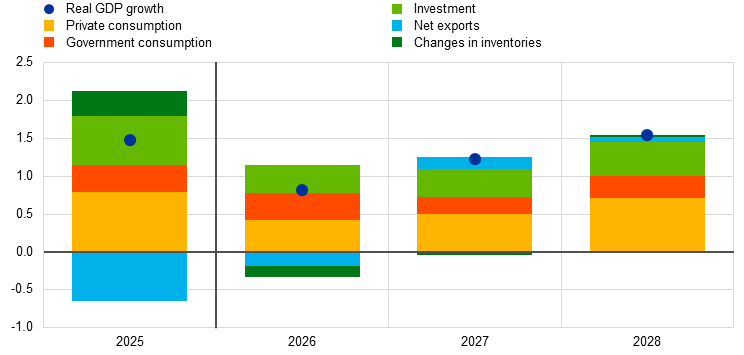
Notes: Data are seasonally and working day-adjusted. Historical data may differ from the latest Eurostat publications owing to data releases after the cut-off date for the projections. The vertical line indicates the start of the projection horizon.
Domestic demand is expected to be supported by the ongoing fiscal stimulus related to defence and infrastructure spending. The impact on growth from fiscal spending on defence and infrastructure, which is mostly accounted for by Germany and will exert the strongest impulse in 2026, is estimated to amount to 0.5 percentage points cumulatively over 2025-28.[4] The energy support measures adopted by governments since the start of the war in the Middle East are predominantly temporary and are seen to have only a marginal impact on growth.
Compared with the March 2026 projections, real GDP growth has been revised down by 0.1 percentage points for both 2026 and 2027 and revised up by 0.1 percentage points for 2028 (Chart 3 and Table 2). The conflict in the Middle East has caused further increases in oil prices, geopolitical uncertainty and volatility in commodity and financial markets. Although GDP growth in the first quarter surprised to the downside, this was mainly due to volatility in Irish data, which has led to relatively large upward revisions to Irish growth in the short term. Aside from this volatility, the downward revision to within-year growth in 2026 mainly relates to a weaker outlook for consumption as the conflict in the Middle East is now assumed to last slightly longer, with a stronger impact on inflation and therefore on real incomes.[5] Towards the end of the projection horizon, the reduction in energy commodity prices, a recovery in real disposable income and improving confidence imply slightly stronger growth in 2028. Given that in the March projections the growth outlook had already been revised down, the expected impact on growth stemming from the war is clearer when the June 2026 projections are compared with the December 2025 projections and amounts to a cumulative downward revision of 0.5 percentage points over 2026-27 and an upward revision of 0.1 percentage points for 2028.
Chart 3
Revisions to real GDP growth projections since the March 2026 projections
a) Decomposition into within-year and carry-over effects |
b) Decomposition into the main expenditure components |
|---|---|
(percentage points) |
(percentage points) |
 |
 |
Notes: The vertical lines indicate the start of the current projection horizon. Revisions are based on unrounded figures.
Table 2
Real GDP, trade and labour market projections
(annual percentage changes, unless otherwise indicated, revisions in percentage points)
|
June 2026 |
Revisions vs March 2026 |
|||||
|---|---|---|---|---|---|---|---|
2025 |
2026 |
2027 |
2028 |
2026 |
2027 |
2028 |
|
Real GDP |
1.5 |
0.8 |
1.2 |
1.5 |
-0.1 |
-0.1 |
0.1 |
Real GDP with modified domestic demand for Ireland1) |
1.1 |
0.9 |
1.1 |
1.5 |
-0.1 |
-0.1 |
0.1 |
Private consumption |
1.5 |
0.8 |
1.0 |
1.4 |
-0.2 |
-0.1 |
0.2 |
Government consumption |
1.6 |
1.6 |
1.0 |
1.3 |
-0.2 |
-0.1 |
0.0 |
Investment |
3.1 |
1.8 |
1.7 |
2.1 |
-0.1 |
0.0 |
0.0 |
Exports2) |
2.1 |
1.1 |
2.6 |
2.9 |
-0.1 |
0.2 |
0.1 |
Imports2) |
3.8 |
1.6 |
2.4 |
3.0 |
-0.4 |
0.0 |
0.1 |
Contribution to GDP from: |
|
|
|
|
|
|
|
Domestic demand |
1.8 |
1.1 |
1.1 |
1.5 |
-0.2 |
-0.1 |
0.2 |
Net exports |
-0.7 |
-0.2 |
0.2 |
0.1 |
0.1 |
0.1 |
0.1 |
Inventory changes |
0.3 |
-0.1 |
0.0 |
0.0 |
0.0 |
0.0 |
0.0 |
Real disposable income |
1.0 |
0.3 |
1.0 |
1.1 |
-0.3 |
-0.2 |
0.2 |
Household saving ratio |
14.5 |
14.1 |
14.1 |
13.9 |
-0.5 |
-0.5 |
-0.6 |
Employment3) |
0.7 |
0.4 |
0.5 |
0.6 |
-0.1 |
0.1 |
0.2 |
Unemployment rate |
6.3 |
6.3 |
6.2 |
6.0 |
0.0 |
-0.1 |
-0.2 |
Current account (% of GDP) |
1.7 |
1.3 |
1.5 |
1.5 |
0.2 |
0.1 |
-0.1 |
Notes: Real GDP and components refer to seasonally and working day-adjusted data. Historical data may differ from the latest Eurostat publications owing to data releases after the cut-off date for the projections. Revisions are calculated from rounded data.
1) Modified domestic demand is described in footnote 3.
2) This includes intra-euro area trade.
3) Persons employed.
The labour market is projected to remain resilient as firms are assumed to hoard labour in reaction to a temporary decline in economic growth owing to the conflict in the Middle East. In 2025 employment growth moderated following years of robust growth, and even prior to the outbreak of the war in the Middle East this rebalancing phase had already been expected to continue in 2026 and 2027. The June 2026 projections reflect expectations that firms will largely retain their workforce in the short term, despite the negative shock to output. As the fallout from the conflict is assumed to be transitory, the benefits firms might gain from layoffs are outweighed by the costs and challenges associated with rehiring later. Employment growth is projected to be slightly lower in 2026 than foreseen in the March projections but to demonstrate more resilience in 2027 and 2028, when it is projected to increase at an annual growth rate of around 0.5-0.6% (Chart 4, panel a). This reflects the dynamics in economic activity, including a more positive outlook for GDP growth in 2028. Nevertheless, employment growth remains below the level suggested by its historical relationship with output, as the labour market continues its rebalancing phase. This adjustment path gives rise to a small downward revision of 0.1 percentage points to labour productivity growth in 2027 compared with the March projections. The unemployment rate is expected to decline over the projection horizon, reaching 6.0% in 2028, which is a downward revision compared with the March projections (Chart 4, panel b). This revision is mostly driven by better than expected recent data for some countries and slightly more positive output and employment growth projected for 2028. Furthermore, structural forces, such as demographics, are expected to contribute to a lower unemployment rate.
Chart 4
Euro area labour markets
a) Employment |
b) Unemployment rate |
|---|---|
(annual percentage changes) |
(percentage of labour force) |
 |
 |
Note: The vertical lines indicate the start of the current projection horizon.
Box 1
International environment
The ongoing war in the Middle East is exerting significant downward pressure on the global economy, driven predominantly by higher energy commodity prices.[6] The blockade of the Strait of Hormuz and the failure so far of peace negotiations have kept energy prices, particularly oil prices, high. These price shocks, and disruptions to supply chains, combined with tighter global financial conditions and heightened geopolitical uncertainty, have dampened the global growth outlook. However, the outlook continues to be supported by robust AI-related investment as well as policy measures.
Global real GDP growth is projected to slow from 3.6% in 2025 to 3.0% in 2026, before recovering marginally to 3.2% in 2027 and 3.3% in 2028 (Table A). Compared with the March projections, the growth outlook has been revised down further for 2026 given the war’s effects on private demand and tighter financial conditions, which are expected to persist throughout the projection horizon.[7] Economic activity in the United States rebounded in early 2026 following the end of a government shutdown, but it is expected to be subdued in the period ahead as a result of higher oil prices. China’s growth is expected to slow to 4.7% in 2026 before stabilising at around 4.0% in subsequent years.
Global inflation is set to rise to 3.5% in 2026, from 3.1% in 2025, driven primarily by higher energy prices but also by prices for non-energy commodities.[8] The inflationary impact is expected to be uneven across regions, with advanced economies and some commodity-importing emerging markets experiencing the strongest effects. Global inflation has been revised up by 0.4 percentage points for 2026 compared with the March projections and by 0.3 percentage points for 2027.
The war in the Middle East is expected to weigh on euro area foreign demand and push up export prices of euro area competitors. Growth in foreign demand is projected to slow sharply from 4.6% in 2025 to 3.2% in 2026, before increasing to 3.4% in both 2027 and 2028. Strong import growth in the first quarter of 2026 reflects higher import demand in the United States, South Korea, China and other countries, partially driven by strong trade in tech-related products and services. It explains most of the upward revision for 2026 compared with the March projections. Looking ahead, global trade should be supported by demand for tech-related goods, reduced uncertainty on trade policies such as tariffs, and a less pronounced slowdown in emerging markets trade than expected in the previous projections. This has led to an upward revision of euro area foreign demand, especially for 2026. Nevertheless, rising energy prices are projected to dampen demand for euro area exports. Euro area competitors are expected to see a significant increase in export prices due to higher energy costs.
Table A
The international environment
(annual percentage changes, revisions in percentage points)
|
June 2026 |
Revisions vs March 2026 |
||||||
|---|---|---|---|---|---|---|---|---|
2025 |
2026 |
2027 |
2028 |
2025 |
2026 |
2027 |
2028 |
|
World real GDP (excluding the euro area) |
3.6 |
3.0 |
3.2 |
3.3 |
0.0 |
-0.3 |
0.0 |
0.0 |
Global trade (excluding the euro area)1) |
5.5 |
4.2 |
3.6 |
3.5 |
0.5 |
1.9 |
0.7 |
0.3 |
Euro area foreign demand2) |
4.6 |
3.2 |
3.4 |
3.4 |
0.3 |
1.1 |
0.4 |
0.1 |
World CPI (excluding the euro area) |
3.1 |
3.5 |
3.0 |
2.5 |
0.0 |
0.4 |
0.3 |
0.0 |
Export prices of competitors in national currency3) |
1.2 |
4.2 |
2.5 |
1.7 |
0.0 |
1.7 |
0.5 |
0.1 |
Note: Revisions are calculated from rounded figures.
1) Calculated as a weighted average of imports.
2) Calculated as a weighted average of imports of euro area trading partners.
3) Calculated as a weighted average of the export deflators of euro area trading partners.
Box 2
Technical assumptions
Compared with the March 2026 projections, the technical assumptions entail notably higher oil prices, a slightly stronger euro, higher interest rates and an increase in the effective US tariff rate on imports from the euro area. Oil prices have risen considerably further since the March projections, given the ongoing Middle East war which has caused severe disruptions to shipments of oil through the Strait of Hormuz, normally accounting for around 20% of the global oil supply.[9] Oil prices are assumed to average USD 112 per barrel in the second quarter of 2026, 25% higher than assumed in the March projections and over 75% higher than in the December 2025 projections. The oil price assumptions for 2027-28 have also been revised up, albeit to a lesser extent, which implies a stronger assumed decline over the projection horizon (-32% up to the end of 2028 compared with -22% in the March projections). Gas price assumptions, in contrast, have been revised down slightly for the short term on account of lower demand, but up later in the horizon, as gas supply disruptions are expected to be more persistent. Electricity prices have been revised up slightly on average over 2026-28.[10] Growth in euro area farm gate prices in 2026 and 2027 has been revised up compared with the March projections, against the background of higher international food and energy commodity prices. The euro has appreciated by 0.7% vis-à-vis the US dollar and by 0.3% in effective terms since the March projections. Market expectations for short-term interest rates have been revised up by 0.3 percentage points for 2027 and by 0.2 percentage points for 2028, while long-term rates have been revised up by 0.1 percentage points across the projection horizon. Following the revisions to the US tariff schedule, the effective US tariff rate on goods imports from the EU has been increased to 12% in the June projections, mainly as a result of new tariffs on patented pharmaceutical products, from the 10.5% estimated in the March projections. It is assumed to stay at this level over the full projection horizon. These rates compare with the estimated 13% US effective tariff rate against all its trading partners, which is broadly unchanged from the March projections.
Table A
Technical assumptions
June 2026 |
Revisions vs March 2026 |
||||||
|---|---|---|---|---|---|---|---|
2025 |
2026 |
2027 |
2028 |
2026 |
2027 |
2028 |
|
Commodities: |
|||||||
Oil price (USD/barrel) |
69.1 |
96.9 |
82.2 |
77.1 |
19.2 |
14.0 |
9.8 |
Natural gas prices (EUR/MWh) |
36.2 |
45.6 |
37.5 |
27.9 |
-1.6 |
2.4 |
6.9 |
Wholesale electricity prices (EUR/MWh) |
83.6 |
89.3 |
78.2 |
68.1 |
1.9 |
0.4 |
4.4 |
EU Emissions Trading System 1 (ETS1) allowances (EUR/tonne CO2) |
73.9 |
74.6 |
76.4 |
79.2 |
2.3 |
4.1 |
4.8 |
EU Emissions Trading System 2 (ETS2) allowances (EUR/tonne CO2) |
- |
- |
- |
46.0 |
- |
- |
0.0 |
Non-energy commodity prices, in USD (annual percentage change) |
5.8 |
3.0 |
0.8 |
-1.9 |
2.2 |
0.3 |
-1.3 |
Euro area farm gate prices (annual percentage change) |
4.1 |
-0.4 |
2.9 |
-0.2 |
1.4 |
0.8 |
-0.7 |
Exchange rates: |
|
|
|
|
|
|
|
USD/EUR exchange rate |
1.13 |
1.17 |
1.17 |
1.17 |
0.6 |
0.7 |
0.7 |
Euro nominal effective exchange rate (EER40) (Q1 1999 = 100) |
128.3 |
130.0 |
129.8 |
129.8 |
0.3 |
0.3 |
0.3 |
Financial assumptions: |
|
|
|
|
|
|
|
Three-month EURIBOR (percentage per annum) |
2.2 |
2.4 |
2.8 |
2.7 |
0.1 |
0.2 |
0.1 |
Ten-year government bond yields (percentage per annum) |
3.1 |
3.4 |
3.7 |
3.8 |
0.1 |
0.1 |
0.1 |
Notes: Revisions are expressed as percentages for levels and as percentage points for growth rates and percentages per annum. Revisions for growth rates and interest rates are calculated on figures rounded to one decimal place, while revisions reported as percentage changes are calculated on unrounded figures. The technical assumptions about euro area interest rates and commodity prices are based on market expectations, with a cut-off date of 21 May 2026. Oil prices refer to Brent crude oil spot and futures prices. Gas prices refer to the Dutch TTF gas spot and futures prices. Electricity prices refer to the average wholesale spot and futures price for the five largest euro area countries. The “synthetic” future price for ETS1 allowances (EUA) is derived as the end-of-month linearly interpolated value of the two nearest European Energy Exchange EUA futures. Monthly EUA futures prices are then averaged to produce an equivalent to annual frequency. In the absence of meaningful trading of ETS2 allowances, the price assumptions were set by staff in line with the assumption of the European Commission in its Autumn 2025 Economic Forecast (see the box entitled “The macroeconomic impact of climate change policies in the euro area” in the December 2025 Eurosystem projections). The paths of commodity prices are implied by futures markets in the ten working days ending on the cut-off date, except for that of euro area farm gate prices, which is forecast using an econometric model that takes into account developments in international food commodity prices. Bilateral exchange rates are assumed to remain unchanged over the projection horizon at the average levels prevailing in the ten working days ending on the cut-off date. The assumptions for euro area ten-year nominal government bond yields are based on the average of countries’ ten-year bond yields, weighted by annual GDP figures. Where the necessary data exist, the country-specific ten-year nominal government bond yields are defined as the ten-year benchmark bond yields prolonged using the forward par yields derived, on the cut-off date, from the corresponding country-specific yield curves. For the other countries, the country-specific ten-year government bond yields are defined as the ten-year benchmark bond yield prolonged using a constant spread (observed on the cut-off date) over the technical euro area risk-free long-term interest rate assumption.
2.2 Prices and costs
Headline HICP inflation rose significantly further in April 2026, with the effects of the war in the Middle East thus far mainly confined to energy prices.[11] The increase in the headline rate to 3.0% in April, from 2.6% in March (1.9% in February), was driven by a surge in energy inflation due to both a month-on-month increase in energy prices and an upward base effect. Food inflation was unchanged, while HICPX inflation declined to 2.2% from 2.3% in March. Lower services inflation more than offset an increase in NEIG inflation amid rising manufacturing input costs and import prices. Overall, the effects of the conflict on non-energy consumer prices remained limited thus far.
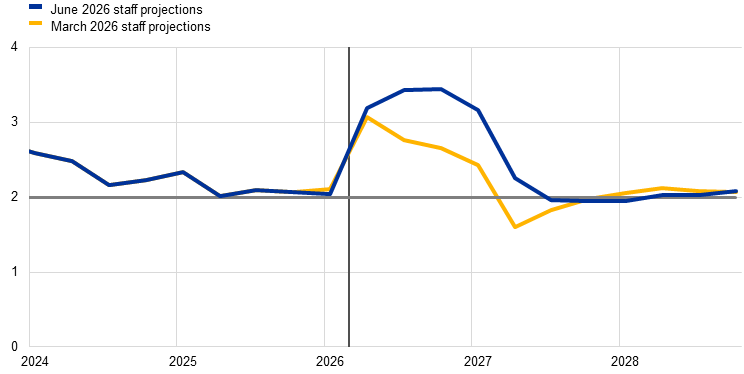
Chart 5
Euro area HICP inflation
a) HICP
(annual percentage changes)
b) HICP and components
(annual percentage changes, percentage points)

Note: The vertical lines indicate the start of the current projection horizon.
Average headline inflation is projected to increase to 3.0% in 2026, mainly driven by higher energy prices, before declining to 2.0% in 2028 as the energy shock fades (Chart 5). Headline inflation is expected to rise to 3.4% in the third quarter of 2026 and to remain elevated until early 2027, driven mainly by the energy component. However, indirect effects from higher energy prices are also expected to materialise gradually, pushing up HICP inflation excluding energy to 2.7% on average in 2027, from 2.3% in early 2026.[12] Indirect and second-round effects included in the baseline projections are expected to be milder than in the inflationary episode of 2021-24. This is mainly because the current total energy cost shock is smaller, with much more limited increases in wholesale gas and electricity prices (Chart 6), but also because of the current less inflationary environment, generally weaker aggregate demand and labour market conditions, and less widespread supply bottlenecks than in the 2021-24 episode. In early 2027 headline inflation is expected to decline because of expected lower energy commodity prices and because of large energy base effects as substantial increases in consumer energy prices this year fall out of the year-on-year comparison. It is therefore projected to fall sharply in the second quarter of 2027 to 2.3% and to stabilise at around 2.0% over the medium term, as the projected contribution from energy inflation is close to zero and the indirect and second-round effects of the energy shock are expected to be contained (Chart 5, panel b). The potential for stronger indirect and second-round effects as witnessed in the previous inflationary shock is considered in the scenario analysis focusing on the impact of the war in the Middle East (see Box 4 ).
Chart 6
Comparison of wholesale energy commodity prices in 2021-22 with those assumed in the current projections for 2026-28
(annual percentage changes, percentage points)
a) 2021-22 |
b) Assumptions for the baseline 2026-28 |
|---|---|
 |
 |
Source: ECB calculations.
Note: The index is an aggregate of crude oil (EUR/barrel) and wholesale gas and electricity prices (EUR/MWh), weighted by the share of the respective energy component in EU final energy consumption.
Energy inflation is projected to peak at 12.5% in the third quarter of 2026, to fall sharply in 2027 owing to lower energy commodity prices and negative base effects, and to rise again in 2028 with the introduction of ETS2 (Chart 7). The profile of energy inflation in 2026 is highly uncertain and reflects assumptions for energy commodity prices, especially oil prices, and elevated refining and distribution margins for transport fuels. Increases in the prices of crude oil and refined oil products are being passed on fully and quickly to consumer liquid fuel prices, in line with historical regularities, and in a rather similar way across countries. In the case of gas and electricity, though, the pass-through from wholesale prices to consumer prices remains lagged and varies across countries. However, recent changes in retail energy markets suggest that retail prices – especially for gas – might react somewhat faster to changes in wholesale prices than in 2022. Given the current profile of the shock, which is concentrated on oil prices, it is expected that the rise in energy inflation will be mostly driven by fuel prices. At the same time, government measures have been announced and will cushion the impact of the energy price increases – these are concentrated in the second quarter and are expected to reduce energy inflation by around 0.6 percentage points on average in 2026. Given declining paths for oil and gas futures and large downward base effects early in 2027, energy inflation is projected to drop into negative territory in 2027. In 2028 the introduction of ETS2 is expected to push energy inflation up.[13]
Chart 7
Euro area HICP energy inflation
(annual percentage changes)

Note: The vertical line indicates the start of the current projection horizon.
Food inflation is projected to increase in the short term on the back of the energy price shock, before receding later in the projection horizon towards 2% (Chart 8). Food inflation is expected to peak at 3.7% in the second quarter of 2027, reflecting increasing domestic food commodity prices related to higher energy and fertiliser costs, as well as other indirect effects of the energy price shock. These factors are expected to more than offset a dampening effect from moderating cocoa and coffee commodity prices and easing wage pressures. Food inflation is projected to decline as commodity prices stabilise and the indirect effects from higher energy prices fade.
Chart 8
Euro area food inflation
(annual percentage changes)

Note: The vertical line indicates the start of the current projection horizon.
HICPX inflation is expected to rise gradually then decline, averaging 2.5% in 2026 and 2027, then 2.2% in 2028 (Chart 9). In the short term HICPX inflation is projected to rise gradually and to peak in the first quarter of 2027 at 2.7%, driven mainly by a pronounced increase in NEIG inflation to 1.5%, while services inflation is expected to be broadly stable at around 3.3%. HICPX inflation is then projected to decline over the course of 2027, driven by a decline in services inflation. NEIG inflation is expected to strengthen further, peaking at 1.6% in the second quarter of 2027, before also declining. This HICPX profile reflects a gradual build-up of indirect effects from higher energy prices both domestically and globally, reflected in higher travel services prices, increasing import prices and hence higher manufacturing input costs, partly tempered by easing labour cost pressures, the past appreciation of the euro and import penetration from China. In 2028 both NEIG and services inflation rates are expected to moderate, with fading indirect effects and limited second-round effects via wages. HICPX inflation is projected to decline to 2.2% in 2028, with services inflation at 2.8% and NEIG inflation at 1.1%. The initially diverging profiles of services and NEIG inflation can be partly explained by the different timing and size of the energy shock pass-through in the two sectors (energy shocks typically have a faster and larger, albeit less persistent, impact on NEIG inflation) as well as by import prices playing a larger role for NEIG inflation.[14]
Chart 9
Euro area HICPX inflation
(annual percentage changes)

Note: The vertical line indicates the start of the current projection horizon. The dashed lines refer to the March 2026 staff projections. The horizontal dotted lines refer to the average rates from the first quarter of 2001 to the first quarter of 2026.
Compared with the March 2026 projections, headline HICP inflation has been revised up by 0.4 percentage points for 2026 and 0.3 percentage points for 2027, while it has been revised down by 0.1 percentage points for 2028 (Chart 10, panel a). The upward revisions to headline inflation stem from revisions to all components and are concentrated in the second half of 2026 and the first half of 2027. The higher inflation profile is in line with recent upside surprises for unprocessed food and HICPX, higher energy and food commodity price assumptions and stronger expected effects of the war in the Middle East on the non-energy components. The downward revision of headline inflation for 2028 is consistent with a slightly stronger decline in oil price assumptions than in the March projections. The higher HICPX profile over the projection horizon reflects both higher services inflation and higher NEIG inflation in 2026 and 2027, with the NEIG component driving upward revisions in 2027-28 (Table 3). As a large part of the energy shock was already incorporated into the March projections, the revisions relative to the pre-conflict projections provide a more complete picture of the impact of the war. Compared with the December 2025 projections, headline inflation has been revised up substantially for 2026 and 2027 (by 1.1 percentage points and 0.5 percentage points respectively), reflecting an immediate effect on energy inflation and its delayed pass-through to non-energy components. However, headline inflation is unchanged for 2028, as a downward direct impact from the energy component broadly offsets an upward indirect impact from non-energy inflation (Chart 10, panel b). HICP energy inflation has been revised up compared with the December 2025 projections by 5.8 percentage points (cumulatively over 2026-28), while HICP inflation excluding energy has been revised up by 1.1 percentage points. The latter revision mainly relates to indirect effects and, to a lesser extent, second-round effects from the energy shock. As these effects may be underestimated by the standard projection models in the context of large shocks to energy prices, some limited upward adjustments have been included, based on staff judgement, to capture stronger pass-through effects from higher energy prices.
Chart 10
Revisions to the inflation projection
a) Comparison with March 2026 staff projections
(percentage points)

b) Comparison with December 2025 staff projections
(percentage points)

Note: Revisions are calculated based on unrounded figures.
Nominal wage growth is expected to ease further throughout 2026, before rising slightly in 2027 and stabilising in the second half of the projection horizon. Growth in compensation per employee decreased in the fourth quarter of 2025, broadly in line with the March projections. It is expected to decline further over the course of 2026, reflecting weak near-term growth momentum, low confidence and high uncertainty, which also support the expectation of a slowdown in negotiated wage growth. Compensation per employee growth is expected to fall from 3.9% in 2025 to 3.2% in 2026, and to remain at that level in 2027 and 2028 as economic conditions strengthen (Chart 11, panel a). Real wage growth is projected to decline in 2026 and to turn negative in the second half of the year, before gradually converging towards productivity growth in 2028 (Chart 11, panel b). Compared with the March 2026 projections, compensation per employee growth has been revised down for 2026 in line with the signs of easing wage pressure from recent data outcomes and wage agreements, and revised up slightly for 2028. The current energy shock is expected to have a limited upward effect on wage growth, with weaker demand conditions and the less broad-based nature of the shock compared with the 2021-24 episode helping to contain second-round effects.
Chart 11
Euro area wage developments
a) Compensation per employee
(annual percentage changes)

b) Real compensation per employee, productivity and unit labour costs
(annual percentage changes)

Notes: The vertical lines indicate the start of the current projection horizon. In panel b), the figures are deflated by the private consumption deflator.
Growth in unit labour costs is projected to decline gradually over the projection horizon (Chart 11, panel b). The slowdown over the course of 2026 is explained by both declining wage growth and increasing productivity growth, whereas developments in the medium term stem from the productivity growth side. Growth in the GDP deflator is also expected to decline, on the back of lower growth in unit labour costs, partly compensated by a higher contribution from unit profits.
Import price growth is expected to increase sharply in the short term before declining in the second half of the projection horizon. In annual terms, the growth rate of the import deflator is projected to stand at 3.7% in 2026, up from 0.0% in 2025, driven by higher energy commodity price pressures, though dampened by the past appreciation of the euro and cheap imports from China. Import price growth is then projected to decline to 1.3% in 2028, reflecting an expected normalisation of global conditions.
Table 3
Price and cost developments for the euro area
(annual percentage changes, revisions in percentage points)
|
June 2026 |
Revisions vs March 2026 |
|||||
|---|---|---|---|---|---|---|---|
2025 |
2026 |
2027 |
2028 |
2026 |
2027 |
2028 |
|
HICP |
2.1 |
3.0 |
2.3 |
2.0 |
0.4 |
0.3 |
-0.1 |
HICP excluding ETS21) |
2.1 |
3.0 |
2.3 |
1.9 |
0.4 |
0.3 |
0.0 |
HICP excluding energy |
2.5 |
2.5 |
2.7 |
2.2 |
0.2 |
0.3 |
0.0 |
HICP excluding energy and food |
2.4 |
2.5 |
2.5 |
2.2 |
0.2 |
0.3 |
0.1 |
HICP excluding energy, food and changes in indirect taxes |
2.4 |
2.4 |
2.5 |
2.2 |
0.2 |
0.3 |
0.1 |
HICP non-energy industrial goods |
0.6 |
0.9 |
1.5 |
1.1 |
0.2 |
0.6 |
0.2 |
HICP services |
3.4 |
3.3 |
3.0 |
2.8 |
0.2 |
0.1 |
0.0 |
HICP energy |
-1.4 |
8.4 |
-1.3 |
-0.1 |
2.2 |
0.7 |
-0.8 |
HICP food |
2.8 |
2.6 |
3.5 |
2.4 |
0.2 |
0.6 |
0.1 |
GDP deflator |
2.5 |
2.4 |
2.5 |
2.1 |
0.0 |
0.2 |
-0.1 |
Private consumption deflator |
2.0 |
3.0 |
2.4 |
2.1 |
0.2 |
0.4 |
0.0 |
Import deflator |
0.0 |
3.7 |
2.1 |
1.3 |
-0.6 |
0.7 |
0.4 |
Compensation per employee |
3.9 |
3.2 |
3.2 |
3.2 |
-0.2 |
0.0 |
0.1 |
Real compensation per employee |
1.8 |
0.1 |
0.8 |
1.0 |
-0.5 |
-0.4 |
0.0 |
Productivity per employee |
0.7 |
0.4 |
0.8 |
1.0 |
0.0 |
-0.1 |
0.0 |
Unit labour costs |
3.1 |
2.8 |
2.4 |
2.2 |
-0.2 |
0.1 |
0.1 |
Unit profits2) |
1.1 |
1.6 |
2.3 |
2.3 |
0.5 |
0.0 |
-0.1 |
Notes: Revisions are calculated using figures rounded to one decimal place. The figures for the GDP and import deflators, unit labour costs, compensation per employee and productivity per employee refer to seasonally and working day-adjusted data. Historical data may differ from the latest Eurostat publications owing to data releases after the cut-off date for the projections.
1) Regarding the impact of ETS2 on the HICP rate in 2028, see footnote 13.
2) Unit profits are defined as gross operating surplus and mixed income (adjusted for the income of the self-employed) per unit of real GDP.
Box 3
Fiscal outlook
After tightening slightly in 2025, by 0.1 percentage points of GDP, the euro area fiscal stance is projected to loosen by 0.5 percentage points in 2026 and then to tighten again somewhat over 2027-28 (Table A).[15] The tightening in 2025 was mainly on account of discretionary increases in social security contributions and other taxes, which were partly offset by additional spending, particularly on government investment and consumption. The loosening on the spending side is seen to continue in 2026, mainly on account of government investment and fiscal transfers. The increase in investment reflects primarily high defence and infrastructure spending in Germany and in some smaller countries, as well as Next Generation EU (NGEU) projects. The tightening of the fiscal stance foreseen for 2027 and 2028 is mainly explained by non-discretionary factors, while, in terms of discretionary measures, expected tightening in many countries, including Italy, France and Spain (among other factors, following the expiration of most NGEU financing), is seen to be broadly offset by stimulus, mostly in Germany.[16]
Compared with the March projections, the fiscal stance is expected to be somewhat looser in 2026 and correspondingly tighter in 2027, while remaining unchanged in 2028. In 2025 an additional slight tightening was mainly on account of government consumption (which surprised on the downside in France), while government investment was slightly higher than estimated in the March projections. The stronger loosening in 2026 compared with the March projections and the corresponding reversal (more tightening) in 2027 are seen to be mainly driven by the new temporary energy support measures adopted by governments since the start of the war in the Middle East (amounting to about 0.1% of GDP) and by government consumption.
The euro area budget deficit and debt ratios are projected to increase, with the deficit peaking in 2027 at well above the 3% threshold and debt reaching 90% of GDP in 2028. After a slightly lower than expected euro area fiscal deficit of 2.9% of GDP in 2025, the deficit is projected to increase sharply to 3.6% of GDP in 2026 and to peak at 3.7% in 2027. Most of the increase in the deficit over the projection horizon reflects a steady rise in interest payments (by about 0.5 percentage points of GDP). In addition, the sharper increase in the deficit in 2026 reflects the loosening of the fiscal stance as described above and a slight deterioration in the cyclical component. The latter is seen to continue in 2027, contributing to a higher deficit, but to reverse in 2028, when, together with the projected fiscal tightening, it leads to a slight improvement in the fiscal position. The euro area debt ratio is on an increasing path as the continuous primary deficits and positive deficit-debt adjustments are seen to outweigh the favourable, though diminishing, effects of interest rate-growth differentials. Compared with the March projections, after small swings over 2025-26, the deficit is seen to remain unchanged in later years, while the debt ratio has been revised up somewhat on account of less favourable interest rate-growth differentials and deficit-debt adjustments.
Table A
Fiscal outlook for the euro area
(percentage of GDP; revisions in percentage points)
|
June 2026 |
Revisions vs March 2026 |
|||||||
|---|---|---|---|---|---|---|---|---|---|
2024 |
2025 |
2026 |
2027 |
2028 |
2025 |
2026 |
2027 |
2028 |
|
Fiscal stance1) |
0.9 |
0.1 |
-0.5 |
0.4 |
0.2 |
0.1 |
-0.2 |
0.2 |
0.0 |
General government budget balance |
-3.0 |
-2.9 |
-3.6 |
-3.7 |
-3.6 |
0.1 |
-0.2 |
0.0 |
0.0 |
Structural budget balance2) |
-3.0 |
-3.0 |
-3.6 |
-3.7 |
-3.7 |
0.1 |
-0.1 |
0.0 |
0.0 |
General government gross debt |
86.6 |
87.4 |
88.7 |
89.4 |
90.0 |
-0.1 |
0.3 |
0.4 |
0.5 |
Note: Revisions are based on unrounded figures.
1) The fiscal policy stance is measured as the change in the cyclically adjusted primary balance. The figures shown are also adjusted for the fact that revenues from grants under the Next Generation EU (NGEU) programme are not withdrawn from the domestic economy. A negative (positive) figure implies a loosening (tightening) of the fiscal stance.
2) The structural budget balance is calculated as the government balance net of transitory effects of the economic cycle (or the cyclically adjusted primary balance, referenced above, plus interest payments) and net of measures classified under the European System of Central Banks definition as temporary.
The main uncertainties surrounding the June 2026 staff projections relate to the current war in the Middle East and its impact on energy prices and uncertainty, and the propagation to the economy.[17] To illustrate these uncertainties, the projections are complemented, as in the March 2026 projections report, with a set of alternative scenarios. They offer illustrative examples of hypothetical alternative paths for energy commodity prices and their propagation to the euro area economy. The staff do not assign any probabilities to these scenarios – they serve rather to illustrate the key uncertainties regarding the impact of the conflict. While the baseline incorporates the energy commodity price paths embedded in the technical assumptions (see Box 2), the alternative scenarios differ in three main respects: the size of the energy shock, the degree of uncertainty and the strength of the transmission of the energy shock to non-energy prices (Table 4). Regarding the transmission, non-linearities and second-round effects on inflation can matter in the context of large shocks, which was an important lesson from the ECB’s 2025 assessment of the monetary policy strategy (see Box 4). Sensitivity analyses for the severe scenario examine the implications of two risks that are currently very prevalent, namely energy-supply rationing and jet fuel shortages. In line with the usual convention for scenario analyses in the staff projections, the scenarios assume that monetary and fiscal policy in the euro area are the same as in the baseline.[18] For short-term and long-term interest rates, the projections are based on market expectations.
Table 4
Narrative of the baseline and alternative scenarios regarding the conflict in the Middle East
Scenario |
Energy commodity prices |
Uncertainty |
Indirect and second round effects on inflation |
Fiscal and monetary policy response in the euro area |
|---|---|---|---|---|
Baseline |
Energy commodity prices follow the technical assumptions1 |
In line with the observed increase in the VIX index in the weeks following the outbreak of the conflict, before its subsequent reversal up to 21 May 2026 |
Limited upward judgment to account for possibly larger impacts compared with the standard model elasticities due to the size of the energy shock |
Short-term interest rates follow the technical assumptions1. Only fiscal policies legislated or announced and well-specified policies are taken into account |
Milder scenario |
Energy commodity prices follow the 25th percentile of the market-implied probability distributions1 |
Unchanged compared with the baseline |
Unchanged compared with the baseline |
None beyond the policies included in the baseline |
Adverse scenario |
Energy commodity prices follow the 75th percentile of the market-implied probability distributions1 |
An increase in the VIX index of around 10 points with a fast reversal at end-2026 towards the Q4 2025 level |
Stronger calibration than in the baseline based on 2021–24 inflation dynamics and satellite models (see Box 4) |
None beyond the policies included in the baseline |
Severe scenario |
Energy commodity prices follow the 95th percentile of the market-implied probability distributions1 |
An increase in the VIX index of around 14 points, and uncertainty remains significantly more elevated thereafter compared with the adverse scenario until end-2027 |
Stronger calibration than in the adverse scenario based on 2021–24 inflation dynamics and satellite models (see Box 4) |
None beyond the policies included in the baseline |
1) Technical assumptions and market-implied probability distributions have a cut-off date of 21 May 2026.
3.1 Key assumptions underlying the alternative scenarios
3.1.1 Energy commodity prices
The alternative scenarios use distributions derived from option-implied densities to define alternative paths for oil and wholesale gas prices. It is assumed that from the third quarter of 2026 oil and gas prices follow the 25th percentile of the market-based distributions in the milder scenario, the 75th percentile in the adverse scenario and the 95th percentile in the severe scenario (Chart 12).[19] These percentiles provide a market-based assessment of the current risks surrounding energy prices and implicitly cover alternative evolutions of the war in the Middle East and its implications for energy supply disruptions.
- In the milder scenario, the oil price drops to USD 88 per barrel and gas prices to €41 per MWh in the third quarter of 2026 and they are around 15-20% below the baseline levels throughout the horizon. This projected path likely reflects investors’ expectations that the conflict could be resolved very swiftly, leading to a rapid normalisation of global oil and gas markets and a return of prices to their pre-war levels by the end of 2026.
- In the adverse scenario, the oil price increases to USD 122 per barrel and gas prices to €60 per MWh in the third quarter and they remain around 20-30% above the baseline levels throughout the horizon, likely reflecting market expectations of a more prolonged conflict than assumed in the baseline scenario.
- In the severe scenario, relative to the baseline, oil prices rise by around 60% and gas prices double, reaching USD 166 per barrel and €98 per MWh respectively in the third quarter. The shocks are also highly persistent, with deviations from the baseline still being of a similar magnitude at the end of the projection horizon. This persistence partly reflects greater uncertainty at longer horizons, which widens option-implied densities. It may also reflect market expectations of a prolonged conflict coupled with significant damage to regional oil and gas production infrastructure, keeping energy prices elevated over an extended period.
Chart 12
Assumptions for the paths of oil and European natural gas prices
a) Oil prices |
b) Gas prices |
|---|---|
(USD per barrel) |
(EUR per MWh) |
 |
 |
Sources: Refinitiv and ECB staff calculations.
Notes: The cut-off date for these assumptions was 21 May 2026.
Table 5
Energy commodity price scenarios – levels and deviations from the baseline
Scenario |
Q3 2026 (USD per barrel or EUR per MWh) |
Q3 2026 (% deviation from baseline) |
Q4 2028 (USD per barrel or EUR per MWh) |
Q4 2028 (% deviation from baseline) |
|
|---|---|---|---|---|---|
Milder |
Oil prices |
88 |
-15% |
64 |
-16% |
Gas prices |
41 |
-16% |
20 |
-22% |
|
Adverse |
Oil prices |
122 |
19% |
90 |
19% |
Gas prices |
60 |
25% |
34 |
31% |
|
Severe |
Oil prices |
166 |
62% |
124 |
63% |
Gas prices |
98 |
104% |
55 |
109% |
Source: ECB and ECB staff calculations.
3.1.2 Uncertainty and its transmission to financing conditions
The adverse and severe scenarios assume that an escalation of the war in the Middle East would increase global uncertainty and trigger repricing in financial markets, though to varying degrees, which would weigh on private consumption, investment and trade. The VIX index is used in the scenarios as a proxy for global uncertainty. It is assumed to spike temporarily in the adverse scenario, and in the severe scenario the spike is assumed to be higher and more persistent. These assumptions are broadly consistent with episodes of comparable geopolitical tensions observed historically, including during Russia’s war against Ukraine and the conflict in the Middle East in October 2023 (Chart 13, panel a). Overall, uncertainty affects the economy in the scenarios in two ways: directly, via its impact on real GDP in the form of confidence shocks, and indirectly by transmission to financing conditions.
Chart 13
Assumptions for the VIX index and impact on selected financial variables
a) VIX index
(index)

b) Corporate bond and firm lending spreads under the adverse and severe scenarios
(basis points, deviations from baseline)

Sources: ECB, CBOE Global Markets and ECB staff calculations.
Notes: In panel a), the baseline refers to an unconditional forecasted path from a Bayesian vector autoregression (BVAR) model and does not correspond to the assumptions underlying the baseline projections in terms of uncertainty effects. The model includes the VIX index, euro area GDP, private consumption, business investment, HICP inflation and short-term interest rates. The VIX index is used as the uncertainty measure since it serves as a direct input into the financial model in panel b). In panel b), the financial variables are the result of a forecast using a mixed frequency daily-monthly Markov-switching BVAR model conditioned on the paths of the VIX index in the scenario. The model includes the VIX index, equities of both banks and corporations, bank bond spreads, the lending spreads of both households and firms, and both short and long-term market rates from the projections. The latest observation for the VIX index is for 21 May 2026.
In the adverse scenario the temporary increase in uncertainty translates into a short-lived impact on the cost of euro area firms’ market-based debt and a relatively muted response of loan pricing, while in the severe scenario the effects are more pronounced given the assumed longer persistence of volatility (Chart 13, panel b).[20] In the adverse scenario, corporate bond spreads increase by about 40 basis points for one quarter but quickly narrow again, as the model predicts a fast return to the low volatility state. In the severe scenario, spreads remain substantially above the baseline until 2027, fading out only towards the end of the projection horizon when the VIX index is in line with a low volatility state. Lending spreads (above the risk-free rate) show a limited and gradual increase in the adverse scenario, as banks would be able to buffer the impact of temporarily higher financial uncertainty, while the increase is more pronounced and protracted in the severe scenario. In the adverse scenario, corporate equity valuations fall by about 7 percentage points on average in the third and fourth quarters of 2026, then recover almost completely in 2027, whereas in the severe scenario they remain more than 10% below the baseline throughout 2027.
3.2 Macroeconomic implications
3.2.1 International environment
As direct trade links with the region affected by the conflict are relatively limited, the transmission of the shock to the global economy is expected to operate mainly through heightened uncertainty, as well as direct and indirect effects of higher energy and food prices (Chart 14). Heightened uncertainty is expected to lower global asset prices, tighten global financing conditions, and weaken global spending and trade. Higher oil and gas prices increase import costs, reduce real incomes and weigh most heavily on energy-importing economies. Rising energy costs also push up food prices, raising inflation and further dampening global demand.[21]
In the adverse scenario, the world economy is hit by a moderate but persistent negative supply shock. The combination of the uncertainty, energy and food channels generates downward pressure on economic activity and upward pressure on inflation. Confidence weakens, import cost pressures rise and real incomes decline. In the United States, GDP growth is projected to be around 0.1 percentage points below the baseline in 2027, while inflation is projected to peak at around 0.6 percentage points above the baseline in 2027. For the global economy excluding the euro area, GDP growth is expected to be around 0.2 percentage points below the baseline in 2027, while inflation is projected to peak at about 0.9 percentage points above the baseline in 2027. For the euro area, the nominal effective exchange rate is expected to depreciate slightly before normalising thereafter, while foreign demand is expected to be about 0.9% below the baseline by 2028.
Chart 14
Impact on the United States and the global economy excluding the euro area
a) United States
(percentage point deviation from baseline growth rate)

b) Global economy excluding euro area
(percentage point deviation from baseline growth rate)

Sources: ECB staff calculations based on ECB-GLOBAL model simulations.
Notes: The simulations are conducted using a forecast setting with the ECB-GLOBAL model in which euro area monetary policy is exogenous.
In the severe scenario, the negative supply shock is much larger and its effects persist for longer. The larger and more persistent energy shock generates a stronger inflation impulse, uncertainty rises more sharply, and larger food-related effects further erode purchasing power across economies. In the United States, GDP growth is expected to be about 0.5 percentage points below the baseline in 2027, while inflation is expected to peak at around 1.7 percentage points above the baseline in 2027. For the global economy excluding the euro area, GDP growth is expected to be around 1 percentage point below the baseline in 2027, while inflation is expected peak at about 2.6 percentage points above the baseline in 2027. For the euro area, the nominal effective exchange rate is expected to depreciate initially and then to normalise thereafter, while foreign demand is expected to be around 3% below the baseline by 2028.
In the milder scenario, these negative spillovers unwind more rapidly – with growth being higher and inflation being lower than in the global baseline projection. As energy prices decline again more quickly, the inflation impulse fades faster, uncertainty recedes, financing conditions normalise and foreign demand is stronger. As a result, global trade performs better and the euro area benefits from a more supportive external environment than in the baseline.
Box 4
Calibrating indirect and second-round effects on euro area non-energy inflation in the alternative scenarios
Prepared by Antoine Kornprobst and Srečko Zimic
The 2021-24 inflationary episode in the euro area provides evidence that the transmission of large energy price shocks can be substantially stronger than implied by historical regularities embedded in standard projection models. Forecast evaluation exercises using the ECB-BASE model suggest that the standard parameters of projection models, based on estimations over a long sample period, imply a substantially smaller pass-through of energy shocks to consumer prices than observed during 2021-24.[22] Chart A shows that alternative (non-linear) empirical frameworks imply a considerably stronger transmission of energy shocks than standard model calibrations. The elasticities from Eurosystem projection models suggest a non-linear adjustment depending on the level of oil prices. An estimated non-linear panel model suggests that the pass-through of energy prices to inflation becomes much stronger when shocks occur in an environment characterised by tight labour markets, elevated inflation and large shocks. Evidence from a Bayesian autoregressive (BVAR) model for inflation points to a similarly strong pass-through of energy prices to consumer prices. A machine learning model that flexibly allows non-linearities points to even stronger impacts of large inflationary shocks (around 1.5 times greater than after medium-sized shocks).[23] Similarly, the Bernanke-Blanchard model, specifically designed to analyse the 2021-24 inflation surge, implies much stronger responses of wages, core inflation and headline inflation than the regular ECB-BASE elasticities. Non-linear versions of structural models such as the New Area-Wide Model (NAWM II) suggest that large energy shocks can generate asymmetric and state-dependent price responses through non-linear Phillips curves and indirect production cost channels.
To account for these findings, the ECB-BASE model is calibrated differently across scenarios to capture part of the stronger indirect and second-round effects that would be likely to materialise under the adverse and the severe scenarios (Chart A). The current environment differs from the 2021-24 inflationary episode, with overall weaker demand, lesser disruption of supply chains, less fiscal support and a somewhat lower degree of labour market tightness, suggesting weaker transmission than observed during that period. At the same time, inflation memory and the more global nature of the current shock could amplify the pass-through. The calibrations therefore aim to capture a plausible increase in transmission compared with the standard ECB-BASE model, which would nonetheless remain below the pass-through observed during the 2021-24 episode. As the purpose of scenario analysis is to assess risks rather than provide the most likely forecast, it is important to consider the possibility of non-linearities. The adverse and severe scenarios therefore incorporate a stronger pass-through to HICP energy and food inflation, a stronger transmission of energy prices to core inflation (i.e. inflation excluding energy and food), greater sensitivity of inflation expectations to realised inflation, and increased wage indexation.[24],[25] The milder scenario assumes the same indirect and second-round effects as in the baseline (see Section 2.2).
Chart A
Energy shock pass-through to headline and core prices across models after 12 quarters

Sources: ECB staff calculations.
Notes: The bars show the average pass-through from energy prices to consumer prices, calculated as the average ratio of price level impulse responses over 12 quarters. The apparent pass-through is measured as the ratio of cumulative deviations of the relevant price index from a 0.5% quarterly growth path to cumulative deviations of a synthetic energy commodity price indicator (SECPI), with deviations calculated relative to the first quarter of 2020. The reported figure is obtained by averaging the quarterly ratios over 2022–24, in order to align the horizon with the 12-quarter model simulations. Using a broader period would not change the qualitative results. Price indices are detrended using 2% annual growth. The pass-through calculations are based on a suite of models, see: Angelini, E., Bokan, N., Christoffel, K., Ciccarelli, M. and Zimic, S., “Introducing ECB-BASE: The blueprint of the new ECB semi-structural model for the euro area’’, Working Paper Series, No 2315, ECB, September 2019; Arce, O., Ciccarelli, M., Kornprobst, A. and Montes-Galdón, C. “What caused the euro area post-pandemic inflation?”, Occasional Paper Series, No 343, ECB, February 2024; Bobeica, E., Holton, S., Huber, F. and Martínez Hernández, C., “Beware of large shocks! A non-parametric structural inflation model”, Working Paper Series, No 3052, ECB, May 2025; Bańbura, M., Bobeica, E. and Martínez Hernández, C., “What drives core inflation? The role of supply shocks”, Working Paper Series, No 2875, ECB, November 2023, revised March 2026; Martínez Hernández, C, “The granular transmission of energy shocks to inflation”, 2026, mimeo; and Coenen, G., Karadi, P., Schmidt, S. and Warne, A., “The New Area-Wide Model II: an extended version of the ECB’s micro-founded model for forecasting and policy analysis”, Working Paper Series, No 2200, ECB, November 2018. The calibrations in the adverse and severe ECB-BASE scenarios recognise that the shocks cross into the region where non-linearities become quantitatively relevant and the linear model’s predictions would underestimate the pass-through. Ex post evaluation of the model forecasting performance during the 2021-24 period has identified the transmission mechanisms behind the errors: an understated pass-through of energy prices to the HICP energy, food and core inflation indices, and too sluggish inflation expectations combined with weak nominal wage indexation. The new calibrations strengthen the pass-through to headline and core inflation by increasing: 1) the pass-through of wholesale commodity prices to consumer energy prices and consumer food prices; 2) the pass-through to non-energy industrial goods and services prices, with broad-based price increases stemming from indirect effects of energy prices on production costs (utilities, intermediate inputs and transport); 3) the rate at which inflation expectations are rising in response to observed inflation; 4) the indexation of wages to past consumer inflation. The pass-through calibration is cross-checked using a suite of models consisting of the elasticities from the euro area aggregation of Eurosystem projection models, a panel model for core inflation, the Bernanke-Blanchard model, the inflation BVAR model, and the non-linear variant of the NAWM II model. Elasticities from Eurosystem projection models are standardised elasticities of key macroeconomic variables to common shocks used across Eurosystem central banks for the staff projections. The panel model is a non-linear pass-through model for HICPX estimated for nine euro area economies (Belgium, Germany, Spain, France, Italy, the Netherlands, Austria, Portugal and Finland) over the period from the first quarter of 2002 to the fourth quarter of 2025. “Low inflation” corresponds to initial conditions of 0% non-core inflation, and “high inflation” to initial conditions of 15% non-core inflation. “Loose labour market” corresponds to initial conditions of the ratio of vacancies to unemployment at its historical mean, and “tight labour market” to initial conditions of the ratio three standard deviations above its historical mean. “Large shock” corresponds to an increase in oil and gas prices by 70% or above, in line with the threshold for large shocks identified in Bobeica, Holton, Huber and Martínez Hernández (2025). The Bernanke-Blanchard model for the euro area has been re-estimated and augmented to allow the price equation to be split into HICP energy, HICP food and HICP excluding energy and food to enable simulation and analysis of the pass-through of a shock to oil and gas prices. The inflation BVAR follows Martínez Hernández, C., “The granular transmission of energy shocks to inflation”, 2026, mimeo, and includes HICP energy, HICP food, HICP services, HICP goods, producer prices, industrial production, oil prices in euro, one-year German government bonds, the BBB-rated euro area corporate bonds, equity prices, Purchasing Managers’ Index supplier delivery times, the Global Supply Chain Pressure Index and negotiated wages excluding bonuses. The variables are transformed into log differences when needed. The model uses the weighted sum of the oil-related and gas shocks from Bańbura et al. (2023) as an internal instrument for energy shocks, considering the same weights for oil and gas as in the SECPI. Two versions of the NAWM II model are used to cross-check the pass-through in a non-linear model variant that embeds a curved relationship between prices/wages and marginal costs as in Harding, M., Lindé, J. and Trabandt, M. "Understanding Post-COVID Inflation Dynamics," IMF Working Papers, International Monetary Fund, 2023. The model is solved first under a standard linearisation approach and second with non-linear methods accounting for a strong curvature of the Phillips relationship. This model variant accounts for a positive pass-through of energy prices in the production of domestic goods, as inspired by the NAWM-E model. In the non-linear model variant, the increase in marginal costs triggers a stronger price response than in the linear version, as firms’ optimal price decision tries to recoup lower profits more aggressively the larger the shock.
3.2.2 Euro area macroeconomic implications
The range of scenarios entails significant downside risks for euro area growth and upside risks for inflation (Table 6 and Chart 15). Both the adverse and the severe scenario imply progressively weaker GDP growth in the euro area (over 2026-27) and higher, more persistent inflation (over the full horizon) compared with the June baseline projections, with the severe scenario pointing to a pronounced deterioration in the outlook driven by sustained energy and uncertainty shocks. Under the milder scenario, economic activity would bounce back and inflation would moderate more quickly.
Table 6
Key euro area variables under the baseline and alternative scenarios(annual percentage changes)
|
Real GDP growth |
HICP inflation |
HICP inflation excluding energy and food |
|||||||
|---|---|---|---|---|---|---|---|---|---|---|
2026 |
2027 |
2028 |
2026 |
2027 |
2028 |
2026 |
2027 |
2028 |
||
June 2026 baseline |
0.8 |
1.2 |
1.5 |
3.0 |
2.3 |
2.0 |
2.5 |
2.5 |
2.2 |
|
Milder scenario |
0.8 |
1.4 |
1.6 |
2.9 |
1.8 |
1.8 |
2.4 |
2.3 |
2.1 |
|
Adverse scenario |
0.7 |
0.9 |
1.5 |
3.3 |
3.0 |
2.3 |
2.5 |
2.7 |
2.3 |
|
Severe scenario |
0.5 |
0.4 |
1.6 |
4.0 |
5.3 |
3.0 |
2.5 |
3.8 |
2.9 |
|
Source: ECB staff calculations based on ECB-BASE model simulations.
In the milder scenario, GDP growth would recover somewhat earlier and inflation would moderate faster than in the baseline. As the energy price rise unwinds more rapidly in this scenario than in the baseline assumptions, inflation would fall below the baseline level, undershooting the 2% target in 2027 and 2028. Lower energy prices would also benefit GDP growth, with real growth settling somewhat above the baseline, at 1.4% in 2027 and 1.6% in 2028.
In the adverse scenario, the shock would lead to a persistent upward shift in energy prices implying more prolonged inflationary pressures, while GDP growth would be weakened in the short term. Real GDP growth slows to below the baseline, at 0.7% in 2026 and 0.9% in 2027, but returns to 1.5% in 2028 as energy prices fall and uncertainty unwinds. HICP inflation rises in this scenario to 3.3% in 2026 and remains elevated at 3.0% in 2027, before reaching 2.3% in 2028. Core inflation peaks in 2027, at 2.7%, reflecting the gradual evolution of indirect and second-round effects across prices and wages, and falls to 2.3% in 2028.
The severe scenario implies a substantially more challenging macroeconomic environment, driven by stronger and more persistent commodity price shocks together with amplified indirect and second-round effects. Real GDP growth falls markedly to 0.5% in 2026, with negative growth in the second half of that year, and 0.4% in 2027, indicating prolonged weakness in activity. It bounces back to 1.6% in 2028. Headline inflation increases sharply, reaching 4.0% in 2026 and peaking at 5.3% in 2027, while core inflation rises substantially as higher energy prices increasingly feed through to domestic prices and wages.
Chart 15
Baseline and alternative scenarios for key euro area variables
Real GDP
(quarter-on-quarter percentage changes)

HICP |
HICPX |
(annual percentage changes) |
(annual percentage changes) |
 |
 |
HICP energy |
HICP food |
(annual percentage changes) |
(annual percentage changes) |
 |
 |
The negative macroeconomic effects of the adverse scenario and the severe scenario initially stem mainly from higher energy costs and uncertainty, but over time arise increasingly through broader spillovers to trade, domestic demand and core inflation. Chart 16 shows that the deterioration in real GDP growth primarily reflects higher energy prices, increased uncertainty and weaker trade. In 2027 the slowdown becomes more pronounced as weaker global demand – in part linked to higher food and energy prices internationally – further weighs on euro area exports, while higher energy prices and tighter financing conditions place an additional drag on domestic demand. By 2028 GDP growth gradually normalises as energy price pressures fade and wages catch up to some extent after the initial decline in real incomes. As regards inflation, the main transmission channel operates through higher energy costs, which exert direct effects on energy inflation but also raise production costs for non-energy products. In the severe scenario, stronger indirect and second-round effects increasingly feed through to food and core inflation, leading to substantially more persistent HICP inflation. In the milder scenario, lower inflation than in the baseline, largely driven by lower energy prices, supports growth, which is further boosted by a more favourable external environment.
Chart 16
Impact on the euro area economy by channel or component across scenarios
a) Real GDP, by channel
(percentage point deviation from baseline growth rate)

b) HICP, by channel
(percentage point deviation from baseline growth rate)

c) HICP, by component
(percentage point deviation from baseline growth rate)

Source: ECB staff calculations based on ECB-BASE model simulations.
Notes: Simulations are conducted under a forecast setting using the ECB-BASE model with exogenous euro area monetary policy.
3.3 Sensitivity analyses of energy supply and jet fuel disruptions under the severe scenario
Sensitivity analyses have been conducted to explore the implications of two additional risk channels, both related to energy products, beyond those incorporated in the scenarios considered. They consist of the impact of energy supply rationing and jet fuel shortages. The sensitivities are presented only for the severe scenario, as these channels are most relevant when shocks are large and persistent and therefore primarily affect tail-risk outcomes. In line with the supply-shock nature of the analyses, real GDP growth would be lower and inflation would be higher in both cases.
3.3.1 Energy supply disruptions
Additional physical energy supply disruptions, as a result of raw and refined energy exports from the Gulf being cut off, might reduce the supply of crude petroleum gas and refined petroleum products in the euro area by 3% and would amplify the impact of the war in the Middle East beyond the price effects embedded in the scenarios. To assess this risk, a multi-country, multi-sector dynamic stochastic general equilibrium (DSGE) model with global production networks is used, enabling analysis of how disruptions to upstream energy inputs propagate across sectors and countries through input-output linkages.[26] The impact on activity is significant, lowering euro area GDP growth by around 0.3 percentage points in 2026 and 2027 (Chart 17). Given the upstream nature of the shock, it also passes through firms’ marginal costs and downstream prices, raising euro area headline HICP inflation by around 0.1 percentage points in 2026, 0.4 percentage points in 2027 and 0.2 percentage points in 2028 on top of the effects triggered in the severe scenario.
3.3.2 Jet fuel shortages
In an event of extreme shortages, global air transport services could fall by 50%.[27] According to a multi-country, multi-sector DSGE model with global production networks, such disruptions to air transport would lower euro area GDP growth by about 0.1 percentage points in 2027 and increase headline and core inflation by around 0.2 percentage points in 2027 and 2028 (Chart 17). The model assumes that replacing air transport with other transport methods would be difficult, especially for international travel and time-sensitive goods.
Chart 17
Sensitivity analysis impacts on euro area growth and inflation under the severe scenario
a) Real GDP growth |
b) HICP inflation |
|---|---|
(percentage point deviation from severe scenario growth rate) |
(percentage point deviation from severe scenario growth rate) |
 |
 |
Source: ECB staff calculations based on ECB-BASE model simulations.
3.4 Caveats to the scenario analysis
These scenario analyses do not include any monetary or fiscal policy responses, which would mitigate the inflation impacts, as well as other channels that could affect the macroeconomic impact. As is the standard convention for scenario analyses in the staff projections, the scenarios assume monetary and fiscal policy are unchanged compared with the baseline. The significant increases in inflation, especially under the severe scenario, would likely be partly offset by tighter monetary policy or fiscal support measures which could lower consumer energy prices – as was seen in the 2022-24 episode of high inflation. Other channels not explicitly included in the analyses are possible positive impacts on tourism in euro area countries, which could benefit from tourism that would otherwise have flowed to the Middle East, and effects stemming from migration pressures related to a potential refugee crisis.
4.1 Alternative energy price paths
Alternative paths for energy commodity prices suggest significant upside risks for inflation, especially in the short term, and downside risks to growth. The staff projections are based on the technical assumptions outlined in Box 2. In this sensitivity analysis, risks are analysed using various percentiles from the option-implied neutral densities for both oil and gas prices.[28] A constant price sensitivity analysis is also carried out for both oil and gas prices. This exercise differs from the Middle East conflict scenarios presented in Section 3 in that only energy commodity prices are affected while in the scenarios uncertainty also played a role in the way the macroeconomic effects were evaluated.[29] The results are shown in Table 7.
Chart 18
Alternative paths for energy price assumptions
a) Oil price assumption
(USD/barrel)
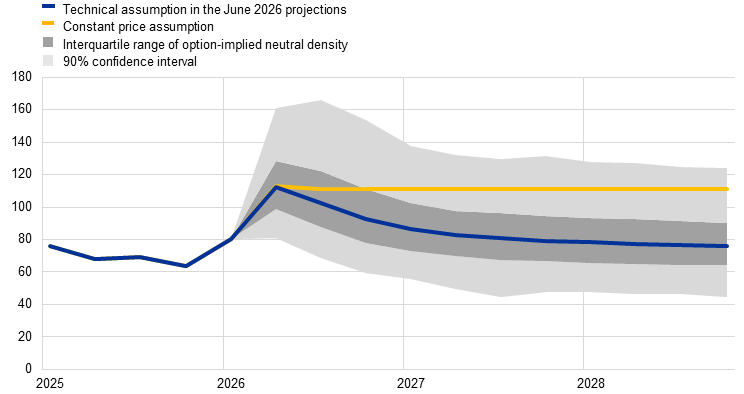
b) Gas price assumption
(EUR/MWh)

Sources: Morningstar and ECB calculations.
Note: Option-implied neutral densities of gas and oil prices are extracted from 21 May 2026 market quotes for options on ICE Brent crude oil and Dutch TTF natural gas futures with fixed quarterly expiry dates.
Table 7
Alternative energy price paths and their impact on real GDP growth and HICP inflation
(deviations from baseline levels, percentages; deviations from baseline growth rates, percentage points)
Oil prices |
Gas prices |
Synthetic energy price index |
Real GDP growth |
HICP inflation |
||
|---|---|---|---|---|---|---|
Path 1: 5th percentile |
2026 |
-25.5 |
-24.9 |
-25.3 |
0.0 |
-0.6 |
2027 |
-39.9 |
-41.3 |
-40.0 |
0.5 |
-1.2 |
|
2028 |
-40.1 |
-46.3 |
-41.8 |
0.5 |
-0.6 |
|
Path 2: 25th percentile |
2026 |
-11.2 |
-11.5 |
-11.2 |
0.0 |
-0.3 |
2027 |
-16.0 |
-20.0 |
-17.1 |
0.2 |
-0.5 |
|
2028 |
-16.2 |
-22.9 |
-17.8 |
0.2 |
-0.3 |
|
Path 3: 75th percentile |
2026 |
14.2 |
17.9 |
15.2 |
0.0 |
0.4 |
2027 |
18.8 |
29.9 |
22.2 |
-0.3 |
0.6 |
|
2028 |
19.0 |
31.6 |
22.6 |
-0.3 |
0.3 |
|
Path 4: 95th percentile |
2026 |
44.9 |
78.8 |
55.8 |
0.0 |
1.2 |
2027 |
61.4 |
116.6 |
78.8 |
-0.8 |
2.1 |
|
2028 |
63.1 |
110.7 |
76.3 |
-0.9 |
1.0 |
|
Path 5: constant prices |
2026 |
7.2 |
-0.9 |
5.3 |
-0.1 |
0.2 |
2027 |
35.0 |
25.2 |
33.6 |
-0.4 |
1.0 |
|
2028 |
43.9 |
68.5 |
52.7 |
-0.5 |
1.0 |
Notes: In this sensitivity analysis, a synthetic energy price index that combines oil and gas futures prices is used. The various percentiles refer to the option-implied neutral densities for the oil and gas prices on 21 May 2026. The constant oil and gas prices take the respective value as at the same date. The macroeconomic impacts are reported as averages of a number of ECB and Eurosystem staff macroeconomic models. In some models, the large inflation response to an energy price increase, under the assumption of a fixed monetary policy, leads to a sizeable decline in real interest rates and a temporary expansionary demand effect, which attenuate the average GDP response in the short run.
4.2 Alternative exchange rate paths
Alternative paths for the exchange rate suggest the possibility of a further appreciation of the euro, especially over the medium term, and hence indicate some downside risks to growth and inflation. The technical assumptions for exchange rates in the baseline projections are held constant over the projection horizon. Alternative downside and upside paths are derived from the 25th and 75th percentiles of option-implied neutral densities for the USD/EUR exchange rate on 21 May 2026, which was tilted towards an appreciation of the euro (Chart 19). This is possibly because market participants’ expectations regarding monetary policy in the euro area relative to the United States, as well as expectations regarding a possible resolution to the war in the Middle East, are providing support to the euro. The impacts of the alternative paths are assessed using ECB and Eurosystem staff macroeconomic models. Table 8 shows the average impact on output growth and inflation across these models.
Chart 19
Alternative paths for the USD/EUR exchange rate

Sources: Bloomberg and ECB staff calculations.
Notes: An increase implies an appreciation of the euro. The 25th and 75th percentiles refer to the option-implied neutral densities for the USD/EUR exchange rate on 21 May 2026.
Table 8
Impact of alternative exchange rate paths on real GDP growth and HICP inflation
Path 1: 25th percentile |
Path 2: 75th percentile |
|||||
|---|---|---|---|---|---|---|
2026 |
2027 |
2028 |
2026 |
2027 |
2028 |
|
USD/EUR exchange rate |
1.15 |
1.12 |
1.11 |
1.18 |
1.23 |
1.28 |
USD/EUR exchange rate |
-1.3 |
-3.8 |
-4.8 |
1.2 |
5.7 |
9.5 |
(deviations from baseline growth rates, percentage points) | ||||||
Real GDP growth |
0.0 |
0.1 |
0.1 |
0.0 |
-0.1 |
-0.2 |
HICP inflation |
0.0 |
0.1 |
0.1 |
0.0 |
-0.2 |
-0.3 |
Sources: Bloomberg and ECB staff calculations.
Notes: An increase implies an appreciation of the euro. The 25th and 75th percentiles refer to the option-implied neutral densities for the USD/EUR exchange rate on 21 May 2026. The macroeconomic impacts are reported as averages of a number of ECB and Eurosystem staff macroeconomic models.
Box 5
Comparison with forecasts by other institutions and the private sector
Forecasts from other institutions and surveys of private sector forecasters display a relatively narrow range for both growth and inflation over the projection horizon, despite elevated uncertainty. The June 2026 Eurosystem staff projections for growth are within the range of other forecasts for 2026-27, and above for 2028. For inflation, the staff projections are above most other forecasts for 2026, with the exception of the latest European Commission forecast. The staff projections are broadly in line thereafter, with all forecasts covered suggesting inflation will return to levels close to target in the medium term. For HICPX inflation, the staff projections are slightly above or at the top of the range of other forecasts throughout the horizon.
Table A
Comparison of recent forecasts for euro area real GDP growth, HICP inflation and HICP inflation excluding energy and food
(annual percentage changes)
|
Date of release |
Real GDP growth |
HICP inflation |
HICP inflation excluding energy and food |
||||||
|---|---|---|---|---|---|---|---|---|---|---|
2026 |
2027 |
2028 |
2026 |
2027 |
2028 |
2026 |
2027 |
2028 |
||
Eurosystem staff projections |
June 2026 |
0.8 |
1.2 |
1.5 |
3.0 |
2.3 |
2.0 |
2.5 |
2.5 |
2.2 |
OECD |
June 2026 |
0.8 |
1.2 |
- |
2.8 |
2.4 |
- |
2.4 |
2.4 |
- |
European Commission |
May 2026 |
0.9 |
1.2 |
- |
3.0 |
2.3 |
- |
2.3 |
2.5 |
- |
Consensus Economics |
May 2026 |
0.8 |
1.2 |
1.4 |
2.9 |
2.2 |
1.9 |
2.3 |
2.2 |
- |
Survey of Professional Forecasters |
May 2026 |
1.0 |
1.3 |
1.3 |
2.7 |
2.1 |
2.0 |
2.2 |
2.2 |
2.1 |
International Monetary Fund |
April 2026 |
1.1 |
1.2 |
1.4 |
2.6 |
2.2 |
2.1 |
- |
- |
- |
Sources: OECD Economic Outlook, 3 June 2026; European Commission Spring 2026 Economic Forecast, 21 May 2026; Consensus Economics Forecasts, 14 May 2026 (data for 2028 are taken from the April 2026 survey); ECB Survey of Professional Forecasters, 4 May 2026; and IMF World Economic Outlook, 14 April 2026.
Notes: These forecasts are not directly comparable with one another or with the Eurosystem staff macroeconomic projections, as they were finalised at different points in time. Additionally, they use different methods to derive assumptions for fiscal, financial and external variables, including oil, gas and other commodity prices. The Eurosystem staff macroeconomic projections report working day-adjusted annual growth rates for real GDP, whereas the European Commission and the International Monetary Fund report annual growth rates that are not adjusted for the number of working days per annum. Other forecasts do not specify whether they report working day-adjusted or non-working day-adjusted data.
Box 6
An update on the performance of Eurosystem/ECB staff projections for growth and inflation
Prepared by Anna-Camilla Hofmann-Drahonsky, Adrian Page and Elena Rusticelli
The accuracy of the Eurosystem/ECB staff projections is regularly assessed to enable lessons to be learned from past errors and to gauge the reliability of the projections for monetary policy decision-making. In line with the ECB’s 2025 assessment of its monetary policy strategy, which suggested that transparent communication on projection errors is also important, every June the Eurosystem staff projections include an evaluation of the errors around growth and inflation projections at different horizons.[30] This box focuses on the recent performance of the projections up to the first quarter of 2026. It shows that errors have been contained overall, notwithstanding some volatility. The ongoing war in the Middle East presents significant challenges to economic forecasting, however, requiring close monitoring of incoming data and readiness to adjust projections quickly to avoid any persistent projection errors.
Short-term projection errors for euro area GDP growth in 2025 were volatile, as a result of trade tensions and elevated global uncertainty, while one-year ahead errors were well below historical averages (Chart A). Stronger than expected euro area exports and investment led to euro area growth in the first and third quarters of 2025 being higher than projected, with one-quarter ahead projection errors above the averages for the period before the COVID-19 pandemic. These underestimations reflect, respectively, the unexpected boost from the large-scale frontloading of purchases ahead of the increases in US tariffs and its slower than anticipated unwinding, especially in Ireland. Nevertheless, after growth surprised significantly on the downside for most of the period 2021-24, one-year ahead errors subsequently declined to well below the pre-pandemic mean absolute error, with some small errors stemming in part from stronger than expected euro area foreign demand. The current war in the Middle East started towards the end of the first quarter of 2026 and therefore had little impact on the one-quarter ahead errors for real GDP growth in that quarter. The large overestimation was due rather to idiosyncratic factors affecting the estimate for Irish GDP, which was strongly negative.[31]
Chart A
Errors in Eurosystem/ECB staff projections for euro area quarterly real GDP growth since 2021
a) One-quarter ahead errors
(percentage points)

b) One-year ahead errors
(percentage points)

Sources: Eurosystem/ECB staff macroeconomic projections and Eurostat.
Notes: In panel a), errors are defined as the actual outcome for a given quarter minus the projection made one quarter earlier (e.g. the real-time outturn for the fourth quarter of 2022 minus the projection from the September 2022 ECB staff macroeconomic projections). In panel b), errors are defined as the actual outcome for a given quarter minus the projection made four quarters earlier (e.g. the real-time outturn for the fourth quarter of 2022 minus the projection from the December 2021 Eurosystem staff macroeconomic projections). Pre-pandemic mean absolute errors refer to the period 1999-2019 and exclude outliers during the global financial crisis.
The accuracy of short-term inflation projections has recently been in line with historical averages and the performance of one-year ahead projections has improved significantly, while volatile energy prices remain a key challenge for short-term inflation projections (Chart B). While one-year ahead projections for inflation were very accurate in 2025, one-quarter ahead errors were more in line with the pre-pandemic absolute mean error (+/- 0.3 percentage points) and were fairly volatile. The volatility closely follows the errors recorded in projecting the energy component of HICP inflation in that period (which in turn largely relate to errors in the technical assumptions for energy commodity prices, based on futures prices at the time the projections were produced). Higher than projected energy inflation was also the main driver of the small positive projection error in the first quarter of 2026, and mainly relates to the outbreak of the war in the Middle East pushing up energy commodity prices, especially for oil, well beyond what had been assumed by markets. Overall, in line with the observed tendency since the pandemic, unanticipated changes in energy prices accounted on average for around 60% of the short-term headline inflation errors in 2025 and 70% in the first quarter of 2026. This compares with the weight of energy in the HICP basket of under 10%.
Chart B
Errors in Eurosystem/ECB staff projections for euro area headline HICP inflation since 2021
a) One-quarter ahead errors
(percentage points)

b) One-year ahead errors
(percentage points)

Sources: Eurosystem/ECB staff macroeconomic projections and Eurostat.
Notes: In panel a), errors are defined as the actual outcome for a given quarter minus the projection made one quarter earlier (e.g. the real-time outturn for the fourth quarter of 2022 minus the projection from the September 2022 ECB staff macroeconomic projections). In panel b), errors are defined as the actual outcome for a given quarter minus the projection made four quarters earlier (e.g. the real-time outturn for the fourth quarter of 2022 minus the projection from the December 2021 Eurosystem staff macroeconomic projections). Pre-pandemic mean absolute errors refer to the period 1999-2019 and exclude outliers during the global financial crisis.
In line with other private sector forecasters and international institutions, Eurosystem/ECB growth projections for 2025 were repeatedly revised in projection exercises in the last two years, owing to high policy uncertainty and repeated data surprises. Chart C shows the evolution of projections for growth and inflation for the year 2025; the outturns are shown as a horizontal line. The first Eurosystem/ECB staff projections for 2025 from the end of 2022 and the first half of 2023 overpredicted growth slightly, in part owing to the stronger than expected appreciation of the euro against the US dollar reducing the competitiveness of euro area exports. From mid-2023 to mid-2024 the growth projections were relatively accurate. However, downward revisions to GDP growth for 2025 starting from the second half of 2024 led to increasingly large underestimations, which peaked in the March and June 2025 projections at the height of the uncertainty relating to tariffs. With the escalation of trade tensions, all forecasters lowered their growth expectations on the anticipation that policy uncertainty would have significant negative effects on firms’ investment decisions and that the tariffs themselves would weigh strongly on export activity. As incoming data surprised on the upside and as trade policy uncertainty declined faster than expected, projections were revised gradually upwards from mid-2025 onwards.
Chart C
The evolution of forecasts of euro area annual GDP growth and average HICP inflation for 2025 across different international organisations and private sector forecasters
a) Real GDP growth
(annual percentage changes)

b) HICP inflation
(annual percentage changes)

Sources: Eurosystem/ECB staff projections, Consensus Economics, ECB Survey of Professional Forecasters (SPF), European Commission, Organisation for Economic Co-operation and Development (OECD), International Monetary Fund (IMF) and Eurostat.
Notes: These forecasts are not directly comparable with one another or with the Eurosystem/ECB staff macroeconomic projections, as they were finalised at different points in time. Additionally, they use different methods to derive assumptions for fiscal, financial and external variables, including oil, gas and other commodity prices. For survey-based sources (Consensus Economics and the SPF), the data points refer to the mean.
For inflation in 2025 the projections of ECB/Eurosystem staff performed well, as did those of other forecasters. Errors were limited and showed no clear tendency. The gap between outturns and the ECB/Eurosystem staff projections fluctuated in a narrow range (-0.1 to +0.1 percentage points), to a large extent mapping changes in the technical assumptions for energy and food prices, as well as for the euro exchange rate. The good performance was broadly matched across forecasters, which all hovered relatively closely around the final outturn.
The risks of projection inaccuracy are currently high, given the elevated levels of uncertainty and commodity price volatility. If the June 2026 projections for inflation in the second quarter of 2026 are correct, the one-year ahead inflation error will be 1.5 percentage points, which would be above the pre-pandemic absolute average shown in Chart B, panel b. While unpredictable shocks mean that forecast errors are inevitable, a number of recommendations were identified in the ECB’s 2025 monetary policy strategy assessment to mitigate future projection misses.[32] These recommendations highlight, for example, the benefits of increased granularity in models and data for monitoring energy sector developments, including information on the role of oil-refining margins. They also emphasise the advantage of an ad hoc shortening of the time between the cut-off date for technical assumptions and publication of the projections, in cases where there is significant new information late in the preparation phase of the projections. This was done in the March 2026 ECB staff projections, and structurally later cut-off dates are also planned for future projections. Finally, the 2025 monetary policy strategy assessment recommended that frequent reviews of the Eurosystem analytical toolkit be carried out to better capture atypical economic fluctuations, and that baseline projections be complemented with scenario analysis, especially in times of high uncertainty, when the risks of larger forecast errors increase. Ongoing efforts to address potential shortcomings in the ECB’s projection tools, which draw on the lessons learned from the high inflation period in 2021-24, include the recalibration in models of the pass-through from energy commodity prices to consumer prices, as well as the re-evaluation of inflation and monetary policy transmission channels embedded in the models, such as those affecting wage-price interactions and inflation expectations (see Box 4).[33]
© European Central Bank, 2026
Postal address 60640 Frankfurt am Main, Germany
Telephone +49 69 1344 0
Website www.ecb.europa.eu
All rights reserved. Reproduction for educational and non-commercial purposes is permitted provided that the source is acknowledged.
For specific terminology please refer to the ECB glossary (available in English only).
PDF ISBN 978-92-899-7735-7, ISSN 2529-4687, doi:10.2866/7558092, QB-01-26-088-EN-N
HTML ISBN 978-92-899-7734-0, ISSN 2529-4687, doi:10.2866/7215101, QB-01-26-088-EN-Q
Legal Disclaimer:
EIN Presswire provides this news content "as is" without warranty of any kind. We do not accept any responsibility or liability for the accuracy, content, images, videos, licenses, completeness, legality, or reliability of the information contained in this article. If you have any complaints or copyright issues related to this article, kindly contact the author above.
